

Use contract engineering staffing when the work has a defined horizon, a manager can direct it, and the team can retain the knowledge afterward. Hire full time when the company needs the capability long term, the person will own continuing decisions, and the company needs the relationship beyond one body of work.
Evidence note. This operating guide distinguishes the work decision from worker classification. It is not legal, tax, or accounting advice.
The wrong opening question is, "Which one costs less?" Cost depends on scope, market, duration, management load, benefits, vendor terms, and the risk of leaving the seat open. Start with the work.
What is contract engineering staffing?
Contract engineering staffing supplies technical capacity for a defined period or assignment. Depending on the arrangement, the engineer may be employed by a staffing firm, supplied by a contract firm, or engaged under another lawful model.
The labels matter less than how the parties work together. The Bureau of Labor Statistics separately counts independent contractors, temporary-help agency workers, and workers provided by contract firms. Its 2023 survey found 11.9 million independent contractors, 945,000 temporary-help agency workers, and 862,000 workers provided by contract firms across the U.S. economy. Those figures are not engineering-specific, but they show why "contractor" is not one uniform category.
Staffing describes the capacity model. Worker classification is a legal and tax question based on the facts.
When should you use a contract engineer?
A contract engineer fits when five conditions are mostly true:
- The capacity gap is visible. A migration, integration, launch, reliability program, or backlog has more work than the current team can absorb.
- The horizon is reviewable. The need has a milestone or date when the company will reassess it.
- A manager owns the work. Someone can set priorities, review decisions, and remove dependencies.
- The team can onboard the engineer. Access, environment setup, documentation, and code review will not consume the entire assignment.
- Knowledge has a destination. Internal people, documentation, tests, and runbooks will hold what matters after the engagement.
A contract hire does not require every ticket to be known. It does require a credible reason the capacity is temporary, variable, or easier to budget separately from long-term headcount.
The model can also fit recurring capacity when the commercial agreement gives the buyer a predictable monthly cost. The value is budget predictability. The role still needs a clear manager and outcome.
When should you hire full time?
Hire full time when the work is part of the company's long-term capability.
That usually means the person will own a system or set of decisions that continue across roadmaps. They will build internal relationships, carry product and customer context, develop other engineers, and absorb responsibilities that should not reset at the end of an assignment.
Signals include:
- The same capability appears in every planning cycle.
- The person will own architecture or operations over several years.
- The role includes hiring, coaching, or organizational leadership.
- Success depends on deep product, customer, or regulatory context.
- The company would replace the person if they left after the current project.
If the last point is already true, the need is probably durable even if the current budget is not.
For leadership roles, settle the mandate before the employment model. The Director-versus-VP guide shows how to separate area execution from function ownership.
How do management and knowledge change the answer?
Contract capacity works only when management capacity exists.
An engineering manager must still explain the operating context, make tradeoffs, review work, and connect the engineer with product and platform owners. A team that is already missing those decisions may need a leader, a bounded outsourced project, or a narrower scope before it adds another contributor.
The more the work depends on business-critical knowledge the company will continue to need, the stronger the case for a full-time owner or a plan to transfer that knowledge.
Write the knowledge-transfer and offboarding requirements before the engagement starts:
- Which systems and decisions must be documented?
- Who will review and accept that documentation?
- Which tests or runbooks prove the team can operate the result?
- Which internal person becomes the owner?
- What access is removed when the assignment ends?
CISA recommends least privilege and separation of duties when setting up third-party access. Offboarding belongs in that same access plan.
Does classification change the decision?
It changes how the arrangement must be structured, but it should not be used as a shortcut for the work decision.
The IRS says employee status depends on the degree of control and independence across behavioral control, financial control, and the relationship between the parties. A contract that calls someone an independent contractor is not enough by itself.
Federal guidance is also moving. The Department of Labor's current rulemaking page says the 2024 final rule took effect on March 11, 2024, and that the department announced a new proposed rule on February 26, 2026. The current rulemaking page should be checked for the latest status. State rules can add other tests. Legal and tax professionals should review the working structure.
A staffing-firm employee assigned to a client is not the same arrangement as a directly engaged independent contractor. Do not let one word collapse those differences.
How should you compare the real cost?
Build two scenarios over the period the work is expected to last.
For a full-time hire, include recruiting effort, salary, payroll costs, benefits, equipment, management time, and the cost of the seat remaining open. Do not use a generic benefits multiplier as if every company and role has the same cost structure.
For contract staffing, include the all-in vendor cost, onboarding, management time, access and security work, planned overlap, knowledge transfer, and any conversion or exit terms.
Then compare three risks:
- Duration risk: What happens if the work ends early or becomes permanent?
- Vacancy risk: What is delayed while the company searches for a full-time hire?
- Continuity risk: What knowledge or ownership disappears when the engagement ends?
The cheaper line item can be the more expensive operating choice if it leaves one of those risks uncovered.
What is the five-part hiring test?
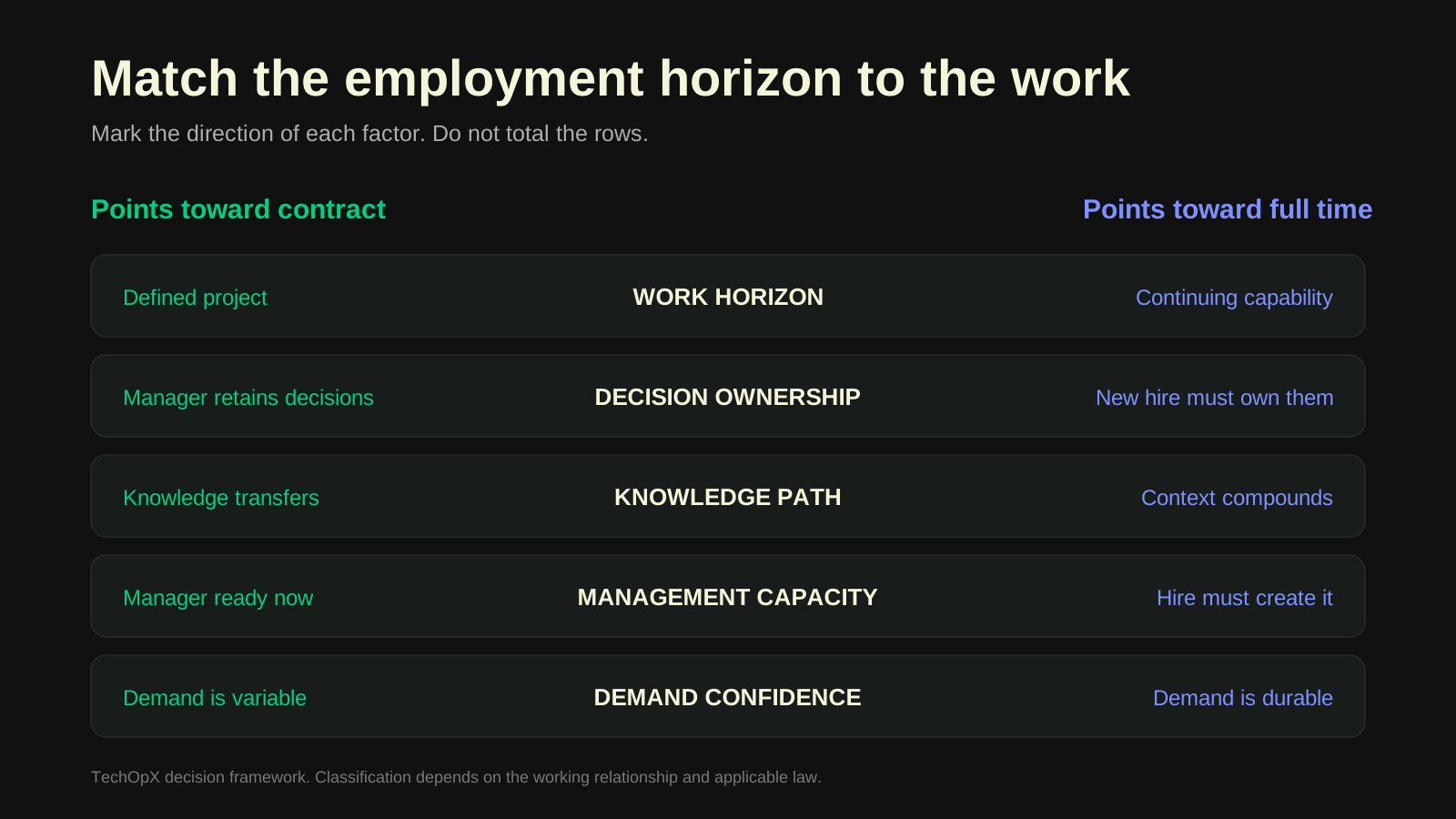
Mark the direction each factor points. Do not total the rows because the factors are not equally important.
FactorPoints toward contractPoints toward full timeWork horizonDefined project or temporary gapContinuing capabilityDecision ownershipExisting manager retains itNew hire must own itKnowledge pathCan be documented and transferredMust compound inside the teamManagement capacityReady nowMust be created by the hireDemand confidenceVariable or milestone-basedDurable and funded
Work horizon starts the decision. Decision ownership and knowledge path can override it. A six-month migration may look temporary, but a full-time hire is more defensible if that person must own the platform after the migration and keep building its context. A recurring backlog may look permanent, but contract capacity can fit if an internal manager retains the decisions and demand will be reassessed after a funded release.
The test does not settle classification or vendor structure. It shows which employment horizon better matches the work and which conflict the hiring team must resolve.
FAQ
Is a contract engineer always an independent contractor?
No. The engineer may be an employee of a staffing or contract firm. Classification depends on the working relationship and applicable law.
Can a contract engineer become a full-time employee?
Sometimes. The agreement should state whether conversion is allowed, when it can happen, and whether a fee applies. The company should also decide what performance evidence would trigger the conversation.
How long should a contract engineering assignment last?
Long enough to reach a defined milestone or review point. The right duration follows the work, onboarding cost, and knowledge-transfer plan.
Should a startup use contractors for core product work?
It can, but core work increases the importance of internal ownership, security controls, documentation, and continuity. If the capability will remain central, build a path to durable ownership.
What should you decide before opening the role?
Name the work horizon, manager, long-term owner, access plan, and conversion trigger. If those five answers are clear, the contract-versus-full-time choice becomes much less subjective.
Then write the role around the work, using the engineering job-description framework. Bring the five answers to a 15-minute TechOpX staffing fit check to compare a contract placement, direct hire, or staged path between them.

