

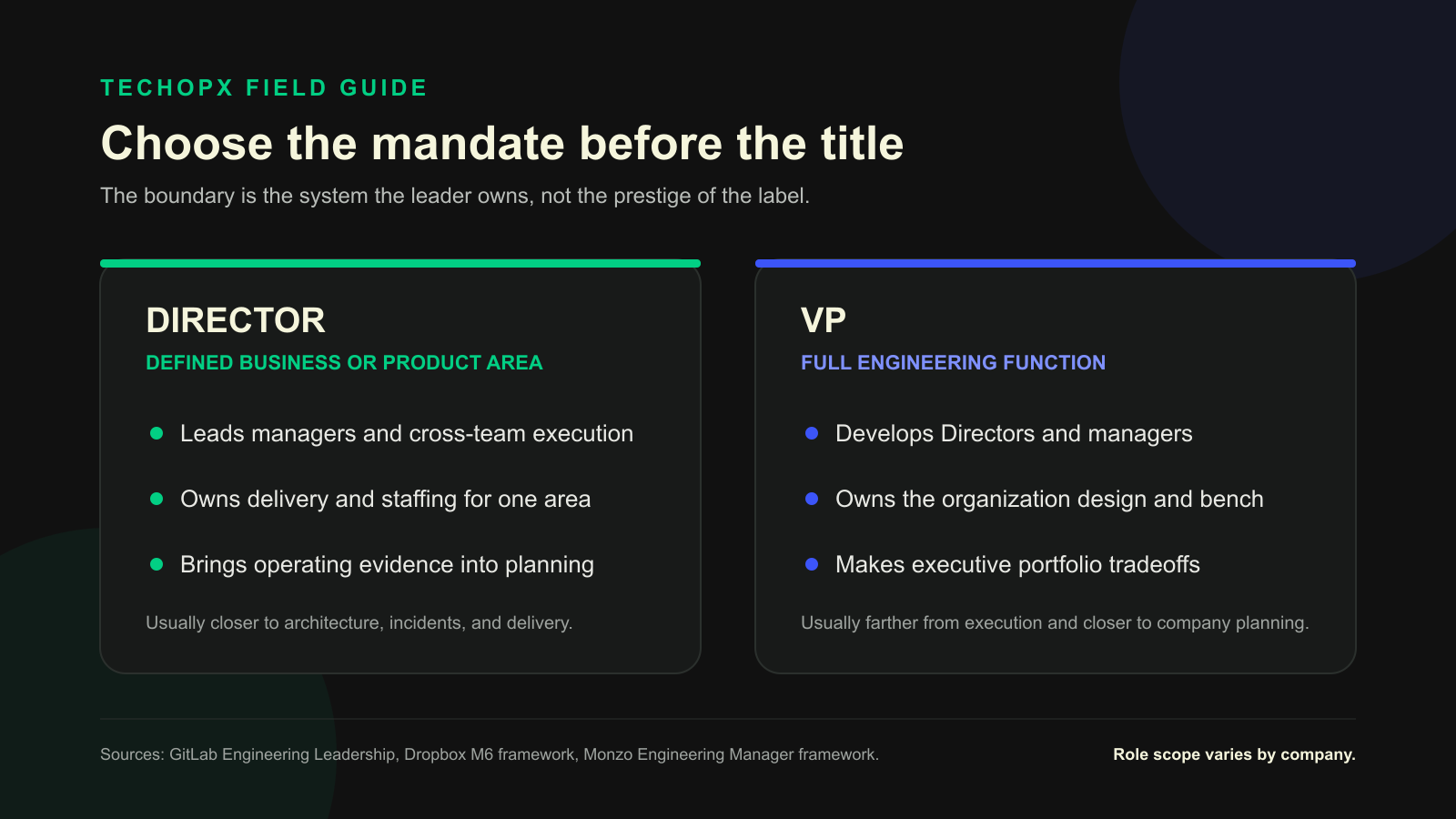
A Director of Engineering usually owns execution across a defined business area or group of teams. A VP of Engineering usually owns the engineering function, its leadership system, and its tradeoffs with the rest of the business. Choose the role from the work, decision rights, and time horizon. Choose the title after those are clear.
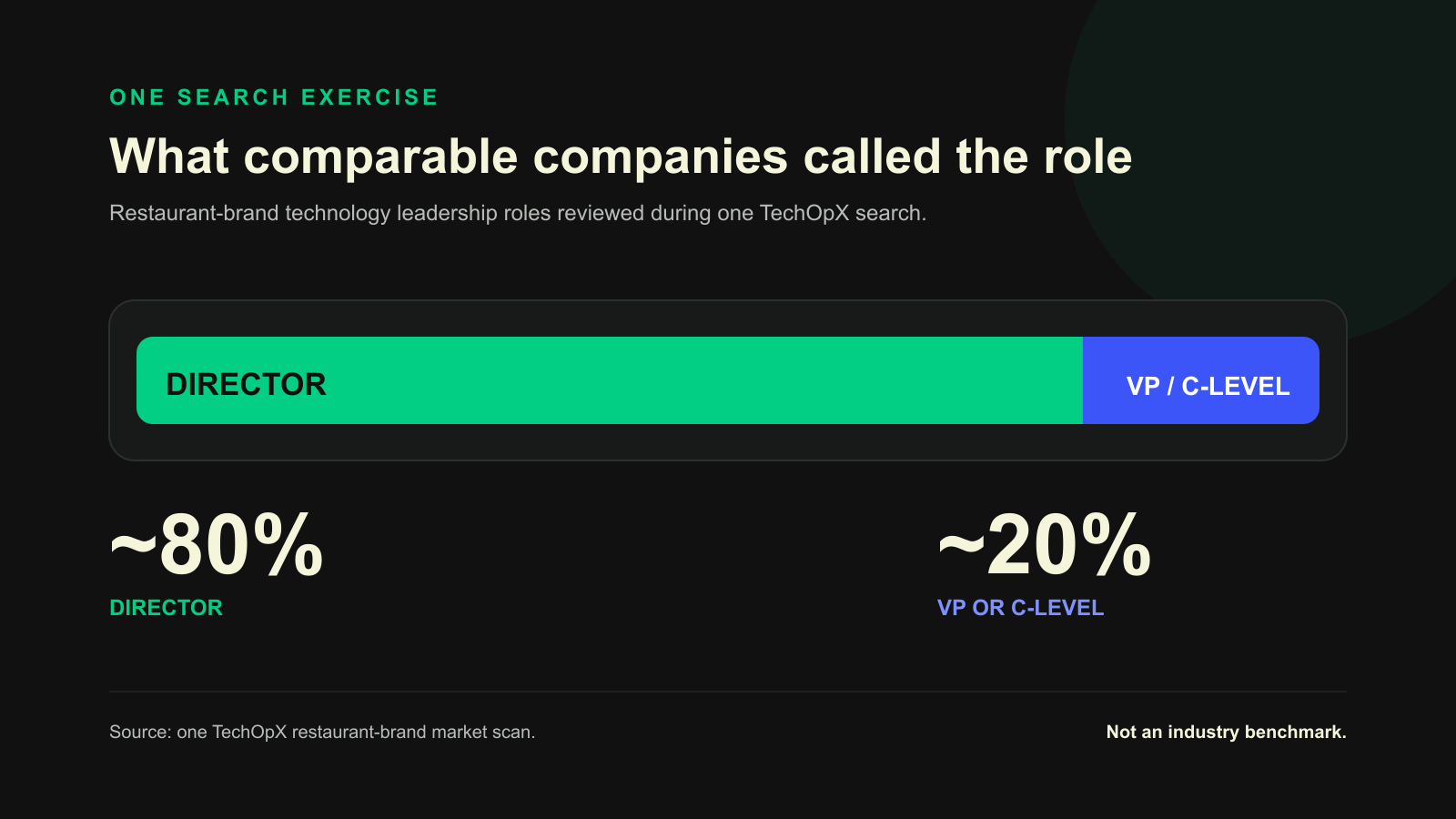
Evidence note. This guide combines one TechOpX restaurant-brand role-leveling exercise with public engineering-leadership frameworks. The approximate 80/20 split belongs to that one exercise, not the industry.
On one restaurant-brand search, the hiring team was stuck between the two titles. I counted comparable technology-leadership roles and found roughly 80% at Director level and 20% at VP or C-level. I recommended Director because the work was still hands-on.
That was one market check for one role, not an industry benchmark. It forced the useful question. What should this person still be doing a year after they join?
There is some irony in the titles. For this role, the Director would do more of the work. The VP would be more likely to build the team and direct it.
What changes between Director and VP?
The practical difference is the size of the system the leader owns.
A Director normally runs a defined area through engineering managers. They turn company and product priorities into staffing decisions, delivery plans, operating standards, and technical tradeoffs for that area. They may still step close to architecture, incidents, hiring loops, or a difficult cross-team dependency when the work demands it.
A VP normally owns the whole engineering operating system. That includes the leadership bench, organization design, hiring plan, executive communication, delivery health, and the balance between product work, reliability, security, and technical debt.
Public frameworks make the boundary visible, but they do not draw it in the same place. GitLab's engineering leadership framework expands the VP role across full functional and product capabilities. Its Director role sits below a Senior Director and extends the scope of a senior engineering manager. Dropbox gives an Engineering Director a company-level objective with a one-to-two-year horizon, which is broader than some companies expect from the title.
That variation is the reason a title alone cannot carry the brief.
Which work must the hire own?
Start with the work that has no clear owner today. Put it into one of two buckets.
Area execution points toward Director. The missing leader needs to coordinate several teams, develop managers, improve delivery in one product or platform area, and translate business priorities into operating decisions.
Function design points toward VP. The missing leader needs to shape the engineering organization and represent it in executive decisions. They own a company-wide hiring and budget plan and build the layer of leaders who will run day-to-day execution.
The distinction becomes easier when the brief names a real operating condition. A hospitality platform may need one leader to stabilize releases across ordering, payments, loyalty, and venue operations. If the role owns that connected area and stays close to delivery, Director may fit. If the role owns the engineering organization across several such areas and has to make the portfolio tradeoffs, VP is more likely.
Monzo's management framework describes an Engineering Director as the technical executive for a business area, including staffing, headcount, and forward engineering investment. That is a good reminder that a Director can carry serious strategic scope without owning the entire function.
How large is the leadership system?
Count leaders and decision layers, not engineers alone.
A 30-person engineering group with four managers, several product lines, and a complex incident load may need a different leader from a 70-person group with experienced Directors already in place. Headcount describes size. It does not describe the management system the new hire must run.
Use these questions:
- Will this person manage engineers, engineering managers, or Directors?
- Do they own one business area or the full engineering portfolio?
- Are they expected to repair delivery inside teams or redesign how teams are organized?
- Who owns engineering headcount, budget, and executive commitments today?
- Which decisions should stop reaching the CTO or CEO after this hire?
If the answers describe a leader of teams and managers inside a defined area, write the Director brief. If they describe a leader of the engineering function and its leaders, write the VP brief.
Who owns executive tradeoffs?
A VP role should have executive decisions to make. Without them, the title may be compensating for an unclear mandate.
Those decisions include how engineering capacity is divided across product growth, platform work, reliability, security, and technical debt. They also include which leadership roles to add, where decision rights sit, and what engineering can commit to the business over the next several quarters.
A Director will influence many of the same decisions, but usually from the evidence inside their area. They bring delivery constraints, team health, technical risk, and staffing needs into a larger planning process.
CoderPad's comparison of the two roles notes that company size and structure can put the same title over very different scopes. Its example treats a Director as a second-line manager and a VP as a third-line manager. It also notes that both titles can cover organizations ranging from 20 to 250 people. Use that as a warning against copying another company's org chart.
What should the role brief contain?
Write five answers before you write the title.
- Mandate. Name the business and engineering problem this leader must change.
- Scope. Name the teams, systems, products, and customer outcomes inside the role.
- Leadership system. Show the current managers, open leadership gaps, and expected direct reports.
- Decision rights. State what the person decides, what they recommend, and what remains with the CTO, CEO, or another executive.
- First-year evidence. Describe what should operate differently after 6 and 12 months.
Then test the title against the brief. Ask two interviewers to read it independently and describe what the person will do in a normal week. If one describes an executive and the other describes a senior delivery leader, the req is not ready.
The same discipline should carry into the posting. The engineering-manager job-description guide shows how to turn scope, decision rights, operating conditions, and first-180-day outcomes into a role a candidate can evaluate.
FAQ
Is a VP of Engineering always above a Director?
Usually, but the title does not prove the scope. Many companies place Directors under a VP. Smaller companies may use Director, Head of Engineering, or VP for the senior operating leader. Read the reporting line and mandate before comparing titles.
When should a company hire a Director of Engineering?
Hire a Director when several teams or managers need one accountable leader for a defined business or product area. That leader owns execution, staffing, technical tradeoffs, and delivery.
When should a company hire a VP of Engineering?
Hire a VP when the company needs one executive to own the engineering function and develop its leadership team. That leader makes organization-wide tradeoffs and represents engineering in company planning.
Can a Director still be hands-on?
Yes, if the role brief requires it. Hands-on should mean close enough to guide architecture, incidents, hiring, or delivery decisions. It should not mean acting as the team's spare individual contributor.
What should happen before recruiting starts?
The hiring team should agree on the mandate, scope, reporting line, decision rights, and first-year evidence. If those answers are unsettled, recruiting will surface candidates for several different jobs.
What should you do before opening the role?
Write the five answers and remove the title. Ask the hiring team to name the level from the mandate alone. Any disagreement belongs in the brief, before it reaches candidates.
Once the role is clear, choose how to run the search. The guide to when subscription recruiting makes sense compares ongoing recruiting capacity with a discrete contingency search.
Bring that role brief to a 15-minute TechOpX staffing fit check. The team can pressure-test the level and build the search around the work the leader will own.

