

Contract-to-hire staffing starts an engineer in a temporary arrangement with a possible later move to direct employment. Before work begins, agree on the evaluation criteria, permanent-hire approval, candidate expectations, and conversion terms so the assignment produces evidence for a possible permanent hire.
Evidence note. This is buyer guidance based on hiring observations and public sources. It does not state TechOpX conversion terms or replace legal or tax advice.
An engineering team may want to see someone work before making a permanent commitment. That can be useful, but a calendar period is not an evaluation plan. If the team cannot say what evidence it needs, who reviews it, and who can authorize the hire, the contract can end with the same uncertainty it began with.
How does contract-to-hire differ from contract staffing?
Contract staffing supplies capacity for the work in front of the team. Contract-to-hire adds a possible employment decision, so the manager must plan both the assignment and the evaluation.
Those arrangements can involve different employers and payment structures. The Bureau of Labor Statistics distinguishes independent contractors, temporary-help agency workers, and workers supplied by contract firms. Do not assume every engineer described as a contractor is self-employed or working under the same model.
Clarify who employs and pays the engineer. Ask who handles:
- Payroll and benefits, where applicable.
- Equipment and time reporting.
- Employment administration during the assignment.
- The changes required if the engineer moves to your payroll.
The answers belong in the agreement, not in an assumption about the phrase contract-to-hire.
If the work is temporary and there is no realistic permanent role, state that clearly. If your team already knows the capability must stay, compare the arrangement with a direct search using the contract-versus-full-time engineering decision. An evaluation period should resolve a question about fit, not conceal the absence of a hiring plan.
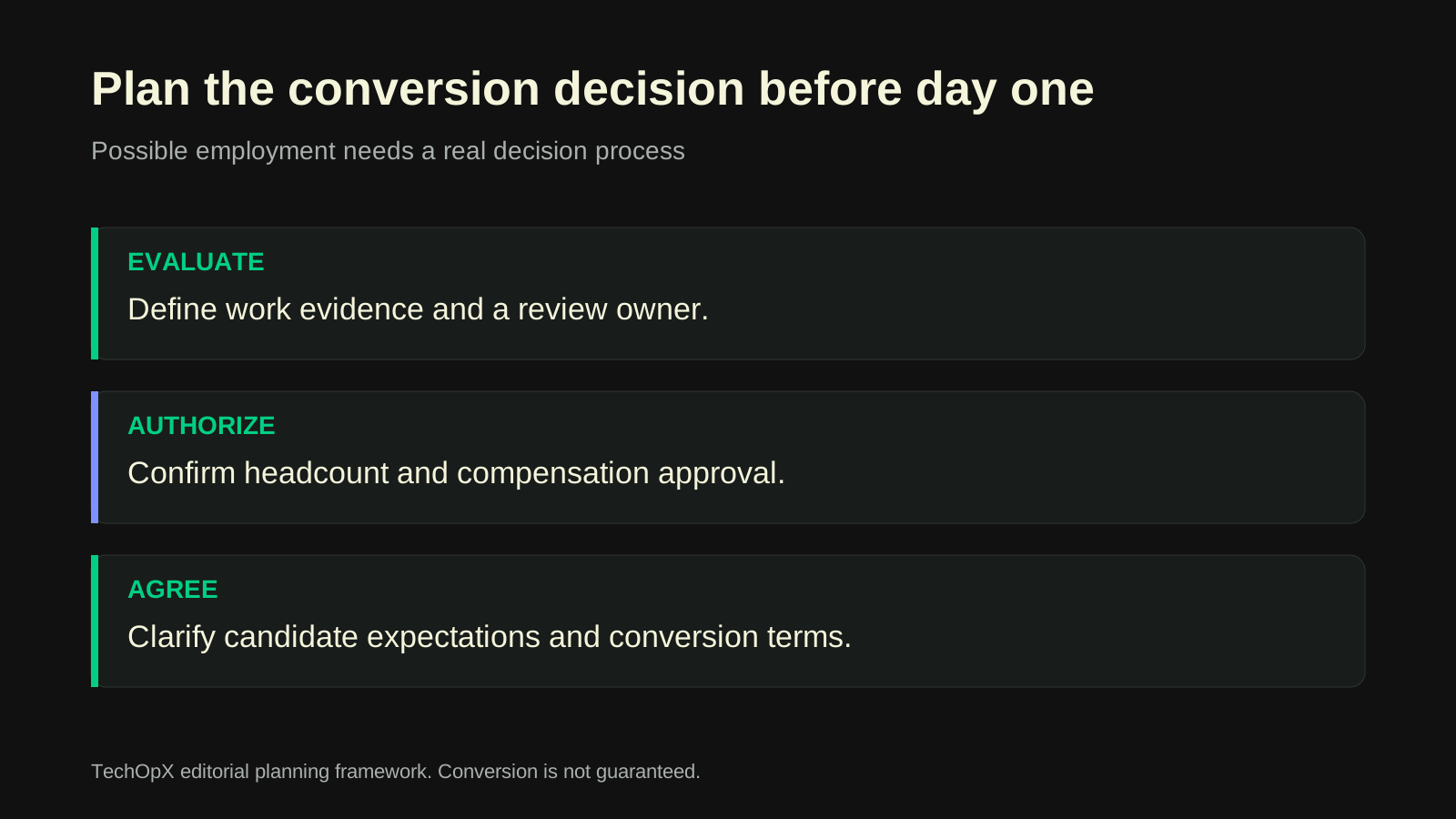
Conversion planning. Define evaluation evidence and its owner, confirm headcount and compensation approval, and agree on candidate expectations and terms. TechOpX editorial framework. Conversion is not guaranteed.
What should the engineering manager evaluate?
Evaluate how the engineer performs the work the permanent role would own. Code output alone can miss judgment, communication, and the ability to leave a system another person can support.
Start with a role brief that identifies the environment, product context, and responsibilities. A request for a Java developer does not tell a recruiting partner whether the work involves an existing service, an integration, a migration, or production support. That missing context also makes the later performance review harder.
Choose evidence the assignment can produce. Suggested evaluation examples include:
- Integration work: explain failure handling, respond to review comments, and document the handoff.
- Infrastructure work: follow safe change procedures and explain how to reverse a change.
These are suggested evaluation examples, not accounts of completed TechOpX placements.
Write the standards before the engineer starts. The Office of Personnel Management's structured-interview guidance uses common questions and rating standards. A work evaluation needs the same discipline. Reviewers should assess the agreed role rather than create new expectations after seeing the person work.
Ask the manager to record what the engineer owned, where support was needed, and whether that support is reasonable for the proposed level. A candidate's adaptability does not justify accepting an unresolved safety or technical requirement. Distinguish what someone can learn from what they must already be able to do.
What belongs in the agreement before work starts?
The agreement should make the possible conversion understandable to the company, staffing partner, and engineer. Use this planning table to prepare questions for the partner and your legal, finance, and HR teams.
Do not treat this table as a contract template. For cross-border work, ask the relevant specialists how employment, payroll, and conversion would operate in the engineer's location. A U.S. hiring plan does not automatically provide a workable employment arrangement elsewhere.
Classification needs its own review. The IRS evaluates behavioral control, financial control, and the relationship between the parties; the contract label alone does not decide independent-contractor status. Confirm the applicable requirements with qualified advisers rather than treating a potential future hire as a classification shortcut.
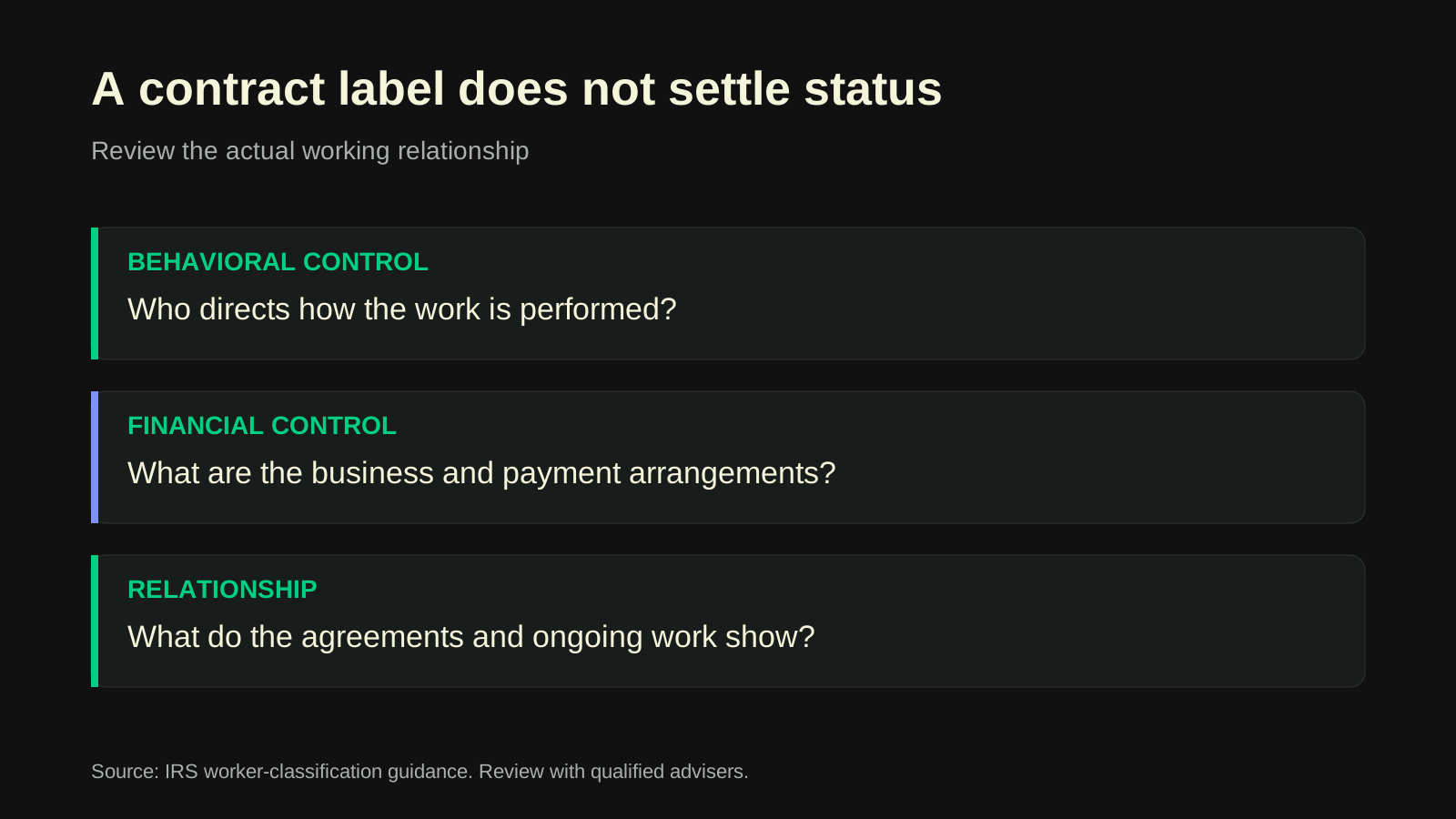
Worker classification. Review behavioral control, financial control, and the relationship between the parties. These IRS categories concern the actual arrangement; the contract label alone does not decide status. Source: IRS guidance linked above.
What if the team likes the engineer but cannot hire?
Separate a positive performance review from authorization to create a permanent role. Both are necessary for conversion, and one does not prove the other.
I saw an engineering-manager search reach offer stage after the client said the offer would go out the following Monday. The offer did not arrive. The client then told me leadership had paused hiring for the quarter. That was a permanent search, not a contract-to-hire placement, but it illustrates why a hiring manager's enthusiasm is not the same as continuing approval.
Recheck approval at the decision point. Confirm three things before giving the engineer a commitment:
- The budget owner can authorize the hire.
- The proposed compensation is permitted.
- Leadership still supports the role.
A positive review cannot substitute for those approvals.
If conversion is unavailable, explain the change promptly and follow the agreed assignment terms. An extension can be an option if all parties agree, but it should not replace a decision indefinitely. Record the reason for extending and the next decision needed.
If you have not decided who should direct the assignment, use the staff-augmentation versus outsourcing comparison based on ownership. A possible permanent hire does not remove the need to name the person managing the work during the contract.
What else do employers ask about contract-to-hire?
Does contract-to-hire guarantee a permanent job?
No. Possible conversion is different from an approved offer. State the conditions and approval status clearly rather than implying a guarantee.
How long should the contract-to-hire period last?
Choose a period that lets the engineer demonstrate the agreed responsibilities, subject to the agreed terms and applicable requirements. There is no universal engineering evaluation duration in this guide.
Is there always a conversion fee?
Do not assume either answer. Ask the partner whether a fee applies, how it is calculated, when it changes, and whether restrictions continue after the assignment.
Can the engineer decline conversion?
Treat the move as a decision for both parties, subject to their agreements. Confirm the engineer's interest, compensation expectations, and proposed employment terms before presenting a final plan.
What is the difference between contract and contract-to-hire?
A contract assignment supplies temporary capacity. Contract-to-hire also contemplates possible direct employment, which requires an explicit evaluation and approval process.
Name the approver, evaluation criteria, and conversion questions before asking for candidates. Use a 15-minute engineering hiring fit check to discuss the staffing need and which arrangement deserves closer review.

