

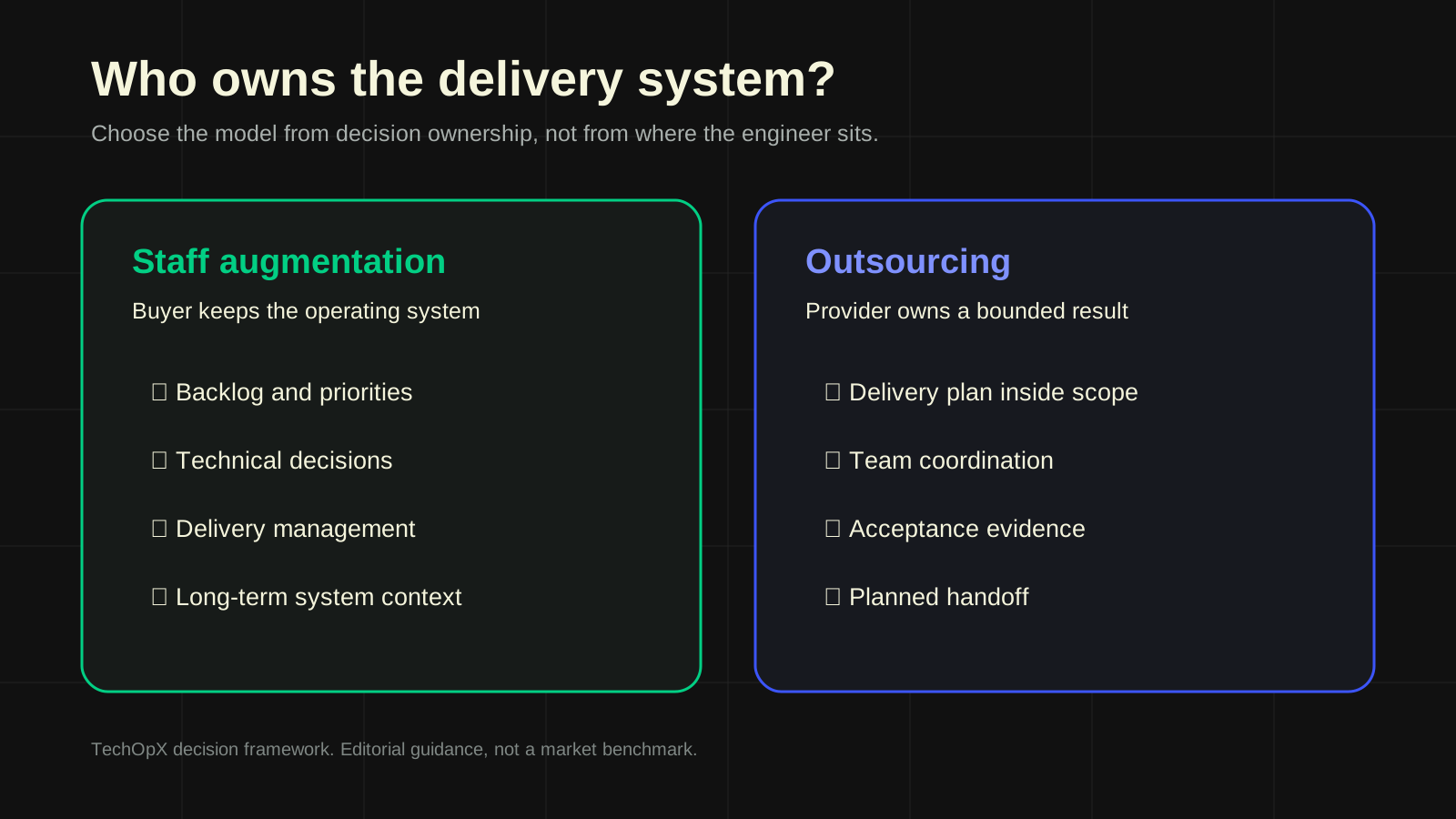
Choose staff augmentation when your team should keep the backlog, technical decisions, and delivery accountability. Choose outsourcing when a provider can own a defined result with clear boundaries, acceptance criteria, and a planned handoff.
Evidence note. This guide combines public workforce and supplier-risk definitions with TechOpX operating experience. It does not provide legal, tax, or security advice.
The useful distinction is not whether outside people write the code. Both models can put external engineers inside the work. The distinction is who owns the system that turns a requirement into a production result.
What is the difference between staff augmentation and outsourcing?
Staff augmentation adds people to a team the buyer already leads. The buyer normally owns prioritization, architecture, delivery management, and the definition of done. The outside engineer works inside that operating system.
Outsourcing gives a provider responsibility for a defined process, project, or result. The provider may supply its own team lead, delivery method, staffing decisions, and internal coordination. The buyer still owns the business outcome, but more of the route to that outcome sits with the provider.
The vocabulary is not perfectly standardized. The American Staffing Association describes long-term and contract help as workers assigned to support or supplement a client's workforce. It defines recruitment process outsourcing separately as transferring all or part of a recruiting process to an external provider. TechOpX uses a similar ownership distinction for engineering delivery. Augmentation supplements capacity, while outsourcing transfers a defined body of operating responsibility.
The Bureau of Labor Statistics also separates contingent status from alternative work arrangements. Its 2023 workforce supplement distinguishes independent contractors, temporary-help agency workers, and workers provided by contract firms. That matters because "external" does not describe one legal or operating model.
Who should own the backlog and technical decisions?
If the work changes every sprint, depends on daily product judgment, or touches systems with shared ownership, keep the backlog and technical decisions inside the company. That points toward augmentation.
An augmented engineer can join planning, pick up work from the same queue, follow the team's architecture standards, and contribute beside internal engineers. The engineering manager still decides what matters now, which tradeoffs are acceptable, and when the work is ready.
Outsourcing fits better when the boundary can be drawn without hiding important dependencies. A migration, integration, test-automation program, or bounded internal tool may be suitable if the provider can accept a clear result and the buyer can verify it.
Run this ownership test before discussing rates:
- Who can change priority after work starts?
- Who approves architecture and security decisions?
- Who breaks the work into deliverable increments?
- Who resolves dependencies with product, data, infrastructure, and support?
- Who decides that the result is accepted?
If the answer is "our engineering team" four or five times, the buyer is retaining delivery ownership and adding capacity.
When does staff augmentation fit better?
Staff augmentation fits when the company has leadership and work, but not enough of the right execution capacity.
Common conditions include:
- A product or platform backlog is already prioritized.
- An engineering manager can onboard and direct another contributor.
- The work needs frequent judgment from people who understand the product and customers.
- Internal engineers must retain architectural and operational context.
- The capacity gap has a defined review point, even if every task is not known today.
The model fails when the company adds a person but leaves nobody accountable for decisions. An external engineer cannot repair a missing product owner, an unresolved architecture dispute, and an overloaded manager by being more available.
That is why the role brief still matters. The engineering job-description framework forces the team to name the operating conditions, decision rights, and evidence of success before another person enters the system.
When does outsourcing fit better?
Outsourcing fits when the result can be bounded and the buyer wants the provider to manage how it gets delivered.
The statement of work should define the result, interfaces, constraints, acceptance tests, documentation, security requirements, and ownership after launch. It should also name the decisions that still require buyer approval. "Build the feature" is not a usable boundary if the feature depends on six internal systems and three teams that the provider cannot direct.
The handoff deserves as much attention as the kickoff. A provider can finish the contracted result while leaving the buyer with code nobody understands, an unsupported deployment path, or operating knowledge trapped outside the company.
Supplier risk is part of the model choice. NIST's cybersecurity supply-chain guidance recommends defining and communicating supplier requirements, while CISA advises organizations to use least privilege and separation of duties for third-party access. Those controls should appear in the engagement design, not after an outside team already has production access.
What should you compare besides hourly cost?
Compare the cost of the operating system around the work.
For augmentation, include the engineering-manager time needed for onboarding, planning, reviews, and feedback. Also include the value of keeping knowledge and technical decisions inside the team.
For outsourcing, include discovery, provider management, acceptance testing, integration, security review, documentation, and handoff. A fixed project price can still become expensive if the boundary changes every week or internal engineers have to rebuild the result.
Use five comparison rows:
Decision factorStaff augmentationOutsourcingBacklog ownerBuyerUsually provider within agreed scopeTechnical decisionsBuyer-ledShared or provider-led within guardrailsDelivery managementBuyerProviderBest fitEvolving work inside an existing teamBounded result with testable acceptanceMain failure modeAdded person without management capacityUnclear boundary and weak handoff
Price belongs under that model, not above it.
How do you choose in one meeting?
Bring the engineering leader, product owner, and security or platform owner into one decision meeting.
Write the result the company needs. Then mark four things as buyer-owned or provider-owned: backlog, technical decisions, delivery management, and handoff. If ownership stays mainly with the buyer, define an augmented role and the manager who will direct it. If ownership moves mainly to the provider, write acceptance criteria and the interfaces the provider must manage.
Do not choose a hybrid by accident. A hybrid can work, but only if each decision has one owner.
FAQ
Is staff augmentation the same as hiring a contractor?
Not always. Staff augmentation describes how capacity enters and works inside the team. The worker may be employed by a staffing firm or engaged under another lawful arrangement. Classification depends on the facts, not the label.
Does outsourcing remove delivery accountability from the buyer?
No. A provider can own delivery inside a defined boundary. The buyer still owns the business outcome, supplier governance, acceptance, and the systems that receive the work.
Can one project use both models?
Yes. A provider might own a bounded migration while augmented engineers work inside the buyer's product teams. The decision rights and interfaces need to be explicit.
Which model is faster?
Neither model is automatically faster. Augmentation can start well when a team already has a clear backlog and manager. Outsourcing can move well when the result and dependencies are stable enough for a provider to own.
What should you do before contacting a provider?
Write four ownership decisions: backlog, technical direction, delivery management, and handoff. Then choose the commercial model that matches those decisions.
If the answer points to added engineering capacity, compare it with the broader subscription recruiting and contingency search decision. Bring the ownership map to a 15-minute TechOpX staffing fit check to pressure-test whether the work calls for one engineer, an augmented team, or a bounded project.

