

Bring in an engineering recruiting specialist when your internal team needs additional technical sourcing or screening capability for a defined role. Keep the search in-house when the team has that capability and enough capacity; outside support should close a specific gap rather than duplicate the hiring process.
Evidence note. This guide draws on recruiting experience and public assessment guidance. The responsibility table is a suggested division of work, not a client case study.
The useful comparison is whether the people working on this search can explain the role, find the right candidates, and give engineering a credible reason to interview them.
An internal team may already own the process well. They know the organization, compensation approvals, and how hiring decisions get made. A specialist can add a narrower capability without taking that knowledge or authority away.
What gap should an engineering specialist fill?
A specialist should fill a named gap in finding candidates, understanding the work, or assessing technical capability. If the problem is missing headcount approval or a hiring manager who cannot review candidates, more sourcing will not resolve it.
Locate the delay before adding a partner. Review the candidates already in the process and match the problem to the next action:
- Too few relevant candidates: consider specialist sourcing.
- Many rejections with unclear reasons: improve the role intake and technical screen.
- Strong candidates waiting on feedback: name an internal owner and reserve interview capacity.
- Panel disagreement about ownership: settle the role's responsibilities before expanding the search.
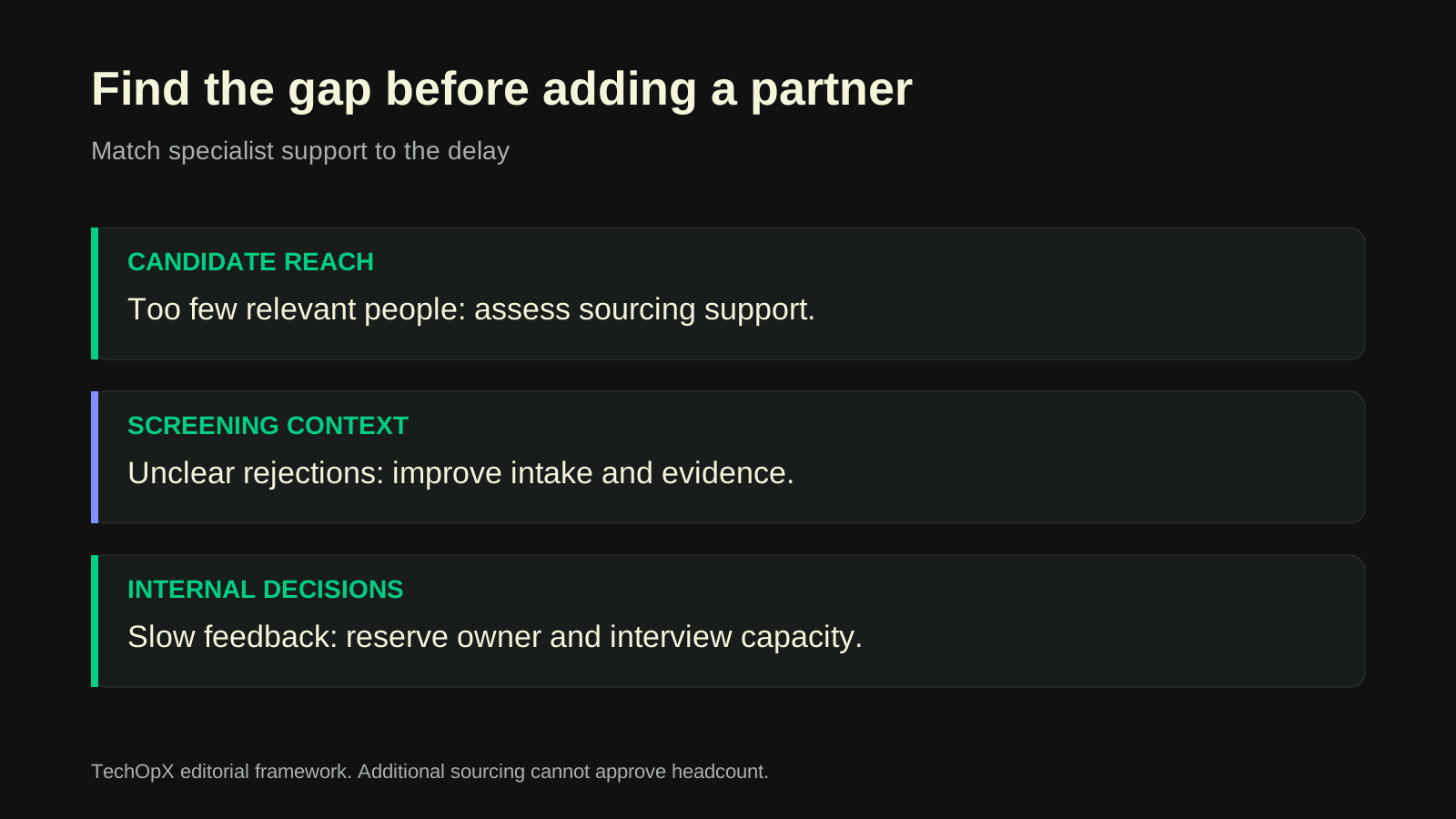
Recruiting diagnosis. A narrow candidate pool may need sourcing support. Unclear rejections need better intake and evidence. Slow feedback needs an internal owner and interview capacity. TechOpX editorial framework, not measured client results.
Our engineering job-description guide starts with the role's responsibilities. Use that work before briefing a partner. An agency cannot reliably distinguish a deployment engineer from a continuing systems owner when the request describes only the programming language.
Technical duties can also include responsibilities that are easy to leave out of a stack list. The NIST Cybersecurity Framework includes cybersecurity responsibilities in human-resources practices. For a role touching production systems, specify the relevant access, change, and risk responsibilities in the brief rather than assuming every technically qualified candidate has owned them.
What screening evidence should the specialist add?
The specialist should make the candidate's relevant work easier to assess. Engineering needs to know what the person owned, which requirements are supported, and which gaps still need testing.
In my technical screens, I ask enough about the work to distinguish personal ownership from a team result or a handoff to another group. A résumé listing a system tells you where to ask questions. It does not settle who designed, changed, operated, or supported that system.
A recommendation should include its limits. In a recent senior product-manager search, the brief included specific technology requirements and a preference for development experience. A referred candidate did not match several of those requirements, but their communication and relevant product experience warranted a closer look. I recommended a conversation with explicit caveats about the gaps.
The hiring manager advanced the candidate, but the candidate was not hired. Another person was further along in the process. The useful part of that example is the reasoned recommendation, not a placement result or a claim that communication overrides technical requirements.
For an engineering role, ask the partner to report evidence against the agreed requirements. The Office of Personnel Management recommends predetermined job-related interview questions and consistent rating standards. Use that principle to make shortlisted candidates comparable, with exceptions explained rather than hidden.
Separate mandatory requirements from preferences before reviewing candidates. If a requirement is necessary for safe execution, an engaging conversation does not replace it. If it is a preference, the partner should explain the evidence that makes an adjacent background worth discussing.
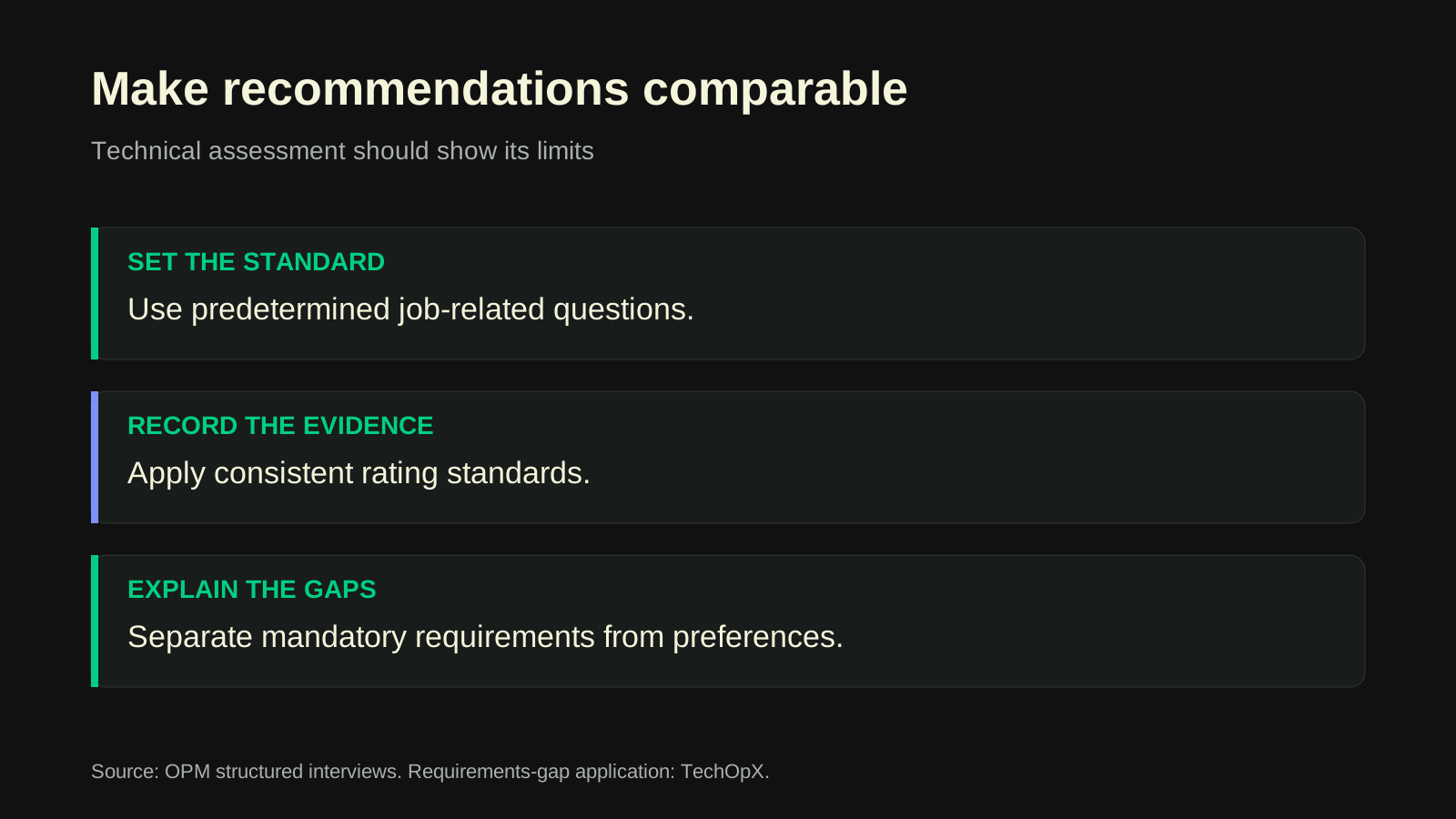
Comparable recommendations. Set job-related questions in advance, use consistent ratings, and disclose mandatory requirements and preference gaps. Assessment principles follow OPM guidance linked above; gap disclosure is TechOpX guidance.
Who should own each part of the search?
The internal team, engineering leader, and specialist should agree on responsibilities before the first candidate arrives. The following division is a starting point to adjust to your organization.
Keep one candidate record. Agree how the teams will handle:
- Introductions and prior applicants.
- Duplicate submissions.
- Interview notes and candidate updates.
- Candidate-introduction terms and fees.
Clarify these before starting so the internal team is not resolving disputes after an offer.
Candidates still need a fair hiring process. EEOC guidance explains employment-discrimination protections for applicants. Internal and external reviewers should use job-related criteria and coordinate with HR on the process; technical credibility does not excuse inconsistent treatment.
When should you keep the search in-house?
Keep the search in-house when the team can reach the relevant candidates, assess them against the role, and move the decision forward. An outside partner needs to contribute something that the existing process lacks.
If the team has a strong engineering recruiter and responsive interviewers, the next improvement may be better role definition or faster feedback. If the role is not funded, stop before adding another sourcing channel. If the technical interview is the delay, decide who will conduct it and reserve that capacity.
For a hospitality software team, missing context might involve integrations, ordering, loyalty, payments, or the operational constraints around deployments. For another engineering organization, the relevant context will differ. Judge the partner by whether they can work with your context, not by whether they list engineering among the industries they cover.
Use the first shortlist to test the working relationship. Check whether the partner:
- Understood the brief and supplied relevant evidence.
- Disclosed requirements gaps.
- Incorporated the engineering team's feedback.
The number of résumés supplied does not answer those questions.
After defining the gap, decide whether you need one search or continuing support. The recruiting-capacity versus individual-hire comparison helps distinguish those engagements without assuming that every specialist relationship should follow the same model.
What else should internal teams clarify?
Does an engineering agency replace internal recruiting?
It does not need to. A scoped engagement can add sourcing or screening while internal recruiting retains process knowledge and coordination.
When should we use a recruiting agency?
Use one when a defined capability or capacity gap affects a funded search and the partner can address it. An unapproved role or slow internal decision process needs a different fix.
Who makes the final hiring decision?
The employer's authorized decision-makers do. A specialist's recommendation supplies evidence; it does not replace engineering, HR, or business approval.
Should every candidate match the exact stack?
Distinguish mandatory requirements from preferences. Consider adjacent experience only when there is evidence of relevant capability and a realistic plan for the gaps.
How should we assess the partner's contribution?
Compare shortlist relevance, disclosed limitations, feedback quality, and work removed from the internal team against the agreed scope. Résumé volume alone is not the outcome.
Write down the gap, the internal owner, and the evidence the next shortlist should contain. Bring that scope to a 15-minute engineering recruiting fit check before adding another partner to the search.

