

Subscription recruiting fits companies with recurring technical hiring, a predictable monthly budget, and useful recruiting work between openings. Contingency search is usually a better fit for an isolated hire or a plan that may stop without warning.
The model should not depend on pretending the company knows every role it will open next year. It should define a hiring range, the role families in scope, the work that continues between reqs, and what happens when demand changes.
Evidence note. This guide combines one prospect objection with current recruiting-model definitions and workforce-planning guidance. It explains how to compare the models; it does not predict hiring outcomes or claim that either model fits every company.
What are subscription and contingency recruiting?
Subscription recruiting
Subscription recruiting is a recurring agreement for defined recruiting capacity or services. The company pays for access to that capacity over a set period, rather than tying the entire fee to one completed hire. Depending on the agreement, the work may include role calibration, sourcing, screening, interview coordination, reporting, or pipeline development. A monthly management fee can fund the recruiting team and operating resources behind the work.
Contingency recruiting
Contingency recruiting is placement-based. The recruiter works an open role, and the company pays when the recruiter's candidate is hired. The American Staffing Association defines contingency fees as fees paid by the client when the employee is hired.
The same role could be run under either model. The commercial unit is different. Subscription buys capacity across a period. Contingency buys a completed placement.
Consider a company expecting an engineering manager, a platform engineer, and recurring backend hiring across 2 quarters, without knowing the exact sequence. A subscription may keep the same recruiting context and candidate work active across those changes. If the company has one leadership opening and no expected follow-on search, contingency keeps the commitment tied to that hire.
You are choosing which uncertainty the agreement should absorb. A monthly commitment can waste budget if hiring stops and the contract has no pause rule. A placement fee limits that exposure, but a later search may begin without the context or pipeline built during the first one.
Why put recruiting on a monthly model?
A monthly model buys continuity. The recruiter learns the engineering environment, keeps likely candidates warm, helps shape roles before they open, and stays available when the hiring sequence changes.
That idea is behind the TechOpX name. I wanted technical recruiting to behave more like a planned operating line than a series of large, one-time fees. The version I described to one prospect averaged expected hiring work across 12 months, then spread the cost across monthly payments.
The objection was fair. The prospect could not see every hire a year ahead.
I still like the model. That objection improved it. A buyer should not pay for certainty that neither side has.
A useful monthly model has to absorb that uncertainty. It should give the buyer enough continuity to avoid restarting from zero, while setting clear limits on capacity and changes in scope.
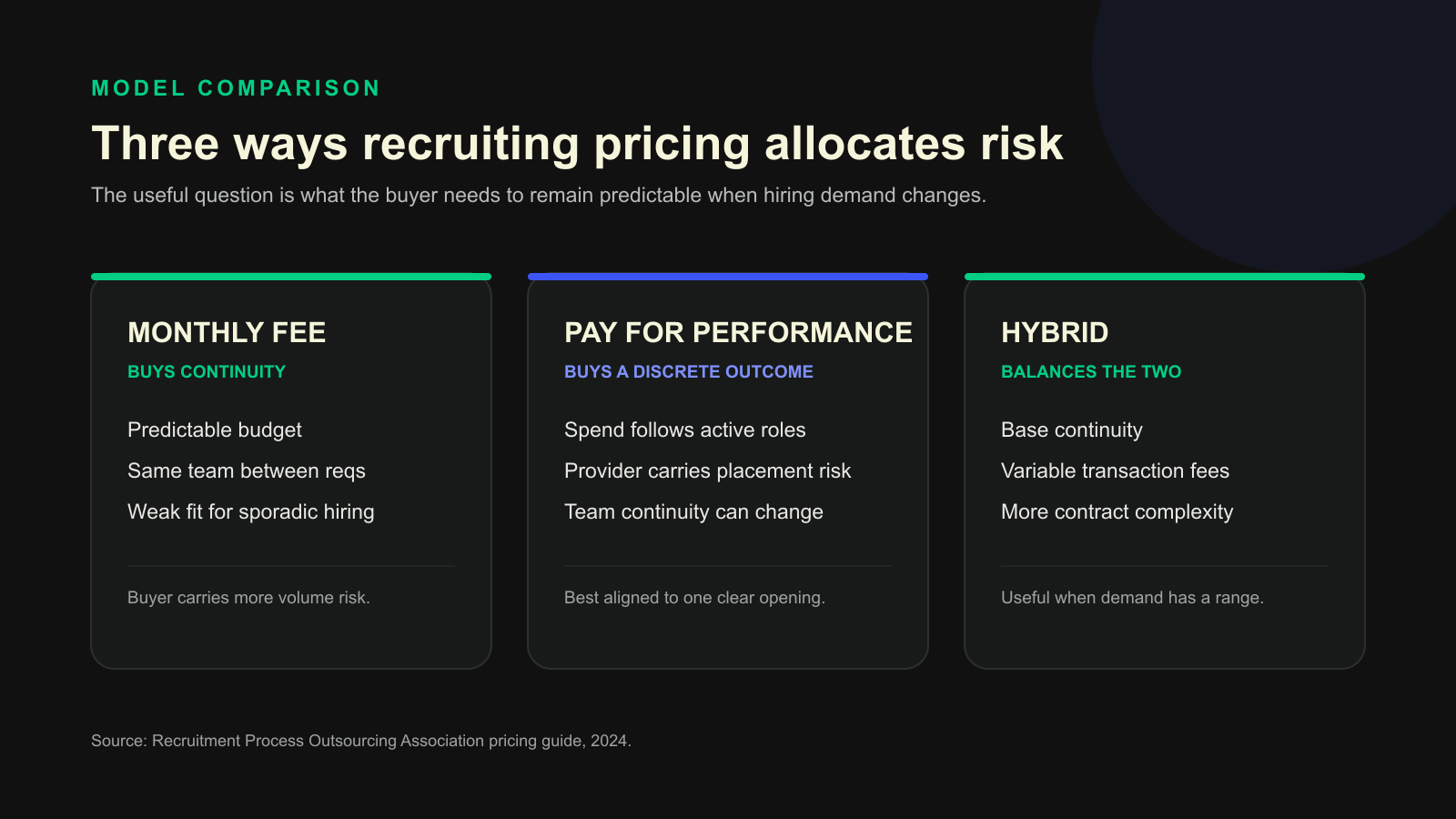
The same pricing guide describes three common structures. A management fee makes cost predictable but can fit poorly when hiring becomes sporadic. Pay for performance follows current hiring volume but may make it harder to keep the same delivery team in place. A hybrid model combines a base fee with transaction-based charges.
Here, "operating expense" describes budget cadence and access to recruiting capacity. It is not accounting advice. Finance should decide the accounting treatment.
When does subscription recruiting fit?
It fits when the recruiting work continues even if a specific req closes.
Look for three conditions:
- Repeated or hard-to-fill role families. The company regularly hires backend engineers, engineering managers, platform specialists, or another defined group where each search benefits from the last one.
- Useful work between openings. Role briefs, market mapping, pipeline development, interview calibration, and candidate follow-up still matter when no offer is going out that week.
- A stable business need with variable timing. The sequence may change, but the need for engineering capacity remains inside the planning horizon.
LinkedIn's candidate-pipeline guidance recommends prioritizing roles a company hires repeatedly or finds hard to fill. That is the simplest fit test. If every likely role is a one-off and there is no reusable market or candidate work, continuity has less value.
What problem does contingency solve better?
Contingency search matches a discrete outcome. A role opens, the recruiter works it, and a fee becomes due when a hire is made.
That structure is useful when hiring is occasional, the role is well defined, and the buyer does not need recruiting capacity between searches. It also shifts more performance risk to the provider because payment depends on a placement.
The tradeoff is restart cost. The next role may begin with a new brief, a new search, and a different recruiter who has to learn the environment again. That cost may be acceptable for one isolated hire. It becomes harder to justify when the company repeatedly hires from the same technical market.
A hiring freeze changes the answer too. If leadership may stop all hiring for a quarter, a monthly commitment needs an explicit pause, reduction, or exit rule. A model that ignores that possibility is not predictable for the buyer.
How should you forecast without false precision?
Forecast a range of work, not a perfect list of future titles.
Start with four inputs:
- Role families the company has hired in the last 12 months.
- Roles or skills likely to recur in the next 2 planning cycles.
- Known product, platform, integration, or reliability work that could create a capacity gap.
- Internal recruiting capacity available for technical sourcing and screening.
Greenhouse's workforce-planning guidance connects hiring plans with skills, retention, finance, operations, and business leadership. That cross-functional view matters because an engineering hiring plan can change when a launch moves, a budget is revised, or an internal leader leaves.
Use a low, expected, and high case. The monthly agreement should work in the low case without wasting the buyer's budget, and it should state what changes in the high case before extra work begins.
What must a subscription agreement define?
Define the unit of service before comparing price.
At minimum, put these five points in writing:
- Capacity. How many active roles, searches, or hours of recruiting work are included?
- Scope. Which role families, locations, seniority levels, and parts of the hiring process are covered?
- Continuity. What pipeline, market, or role-design work continues between open reqs?
- Change rules. What happens when a role closes, hiring pauses, or the company adds a different search?
- Accountability. Which measures are reviewed monthly, and who owns decisions on both sides?
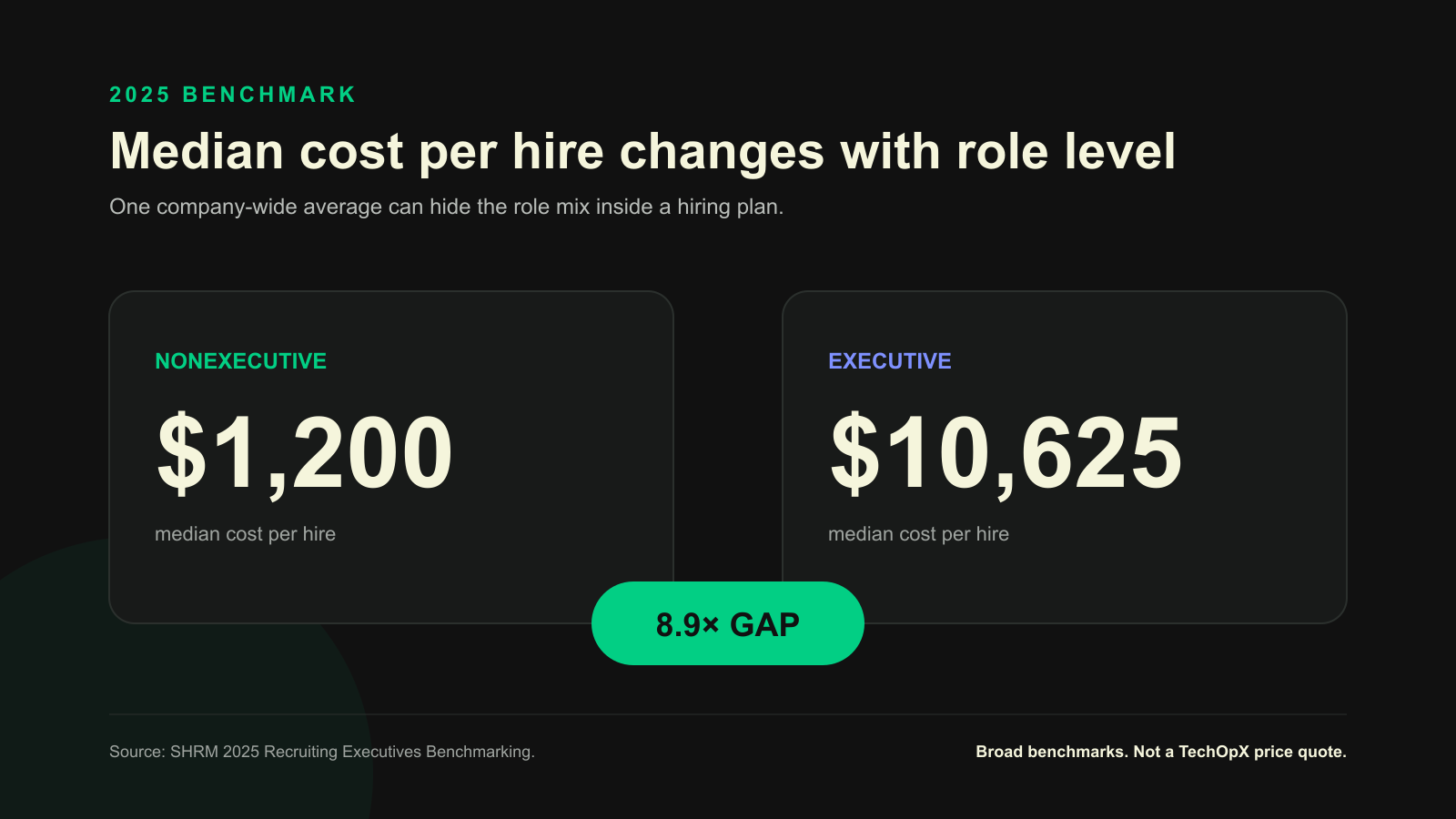
Cost per hire can inform the comparison, but one company-wide average can hide the role mix. SHRM's 2025 recruiting benchmark reports a $1,200 median cost per hire for nonexecutive roles and $10,625 for executive roles. Those are broad benchmarks, not a quote for technical recruiting. They show why a mixed plan needs more detail than "expected hires multiplied by one fee."
How do you compare the two models?
Run the comparison against the next 12 months of work.
Choose subscription recruiting when recurring role families, pipeline continuity, and planning support remain valuable across the year. Choose contingency when the company has one defined opening and does not need the recruiting system to stay active after it closes.
Then test the role briefs. A monthly model cannot rescue an unclear search. Before sourcing starts, use the engineering-manager job-description framework to define the work, team context, decision rights, and evidence of success. For a senior leadership role, the Director-versus-VP checklist helps settle the level before the market sees the req.
FAQ
What is subscription recruiting?
Subscription recruiting is an agreement in which a company pays a recurring fee for defined recruiting capacity or services over a set period. The contract should state the capacity, scope, performance measures, and rules for changing demand.
How is it different from contingency recruiting?
Contingency recruiting usually ties payment to a successful placement for a specific role. Subscription recruiting pays for ongoing capacity and work that can continue across several searches.
Does a monthly model require an exact annual hiring plan?
No. It requires a credible range and clear scope. The agreement should explain how priorities change, what happens during a slowdown, and when added demand changes the fee or capacity.
Which technical roles fit a subscription model?
Repeated or hard-to-fill role families fit best because market knowledge, candidate relationships, and calibrated screening can carry from one search into the next.
What should a buyer measure each month?
Measure work the provider can influence. That can include role-brief completion, qualified candidates presented, stage conversion, time in each hiring stage, hiring-manager response time, and accepted offers. Define each measure before the engagement begins.
What should you do before choosing a model?
List the likely role families, planning range, recruiting work that continues between openings, and the rule for a hiring pause. If those answers are blank, keep the commitment narrow until the business need is clearer.
Bring that one-page scope to a 15-minute TechOpX staffing fit check. The team can tell you whether a monthly model, a discrete search, or a different staffing approach fits the work.

