

AI resume screening works only after the hiring team defines the evidence that should advance a candidate. If the role is vague or the filter rewards keyword overlap, automation can process more applications without producing a better engineering shortlist.
Evidence note. One TechOpX backend-engineer posting received roughly 1,000 applications in a week. I estimated that about 95% were low-quality or weak-fit submissions. That is one search, not an industry benchmark. External application figures below are attributed vendor research.
The volume was not the useful part. The useful part was how quickly keyword similarity stopped distinguishing real fit.
Why are engineering teams getting more applications?
Employers are reporting more applications while both sides add automation to hiring and job search.
A 2026 vendor survey from ZipRecruiter found that 48% of employers said AI had increased application volume per role. The survey covered more than 1,000 verified talent-acquisition professionals and hiring managers. It is useful directional evidence, but it is still research published by a job marketplace.
Platform data points in the same direction. Greenhouse reports that applications per job rose from 116 in 2022 to 244 in 2025. Those figures describe activity in its own customer dataset, not every employer.
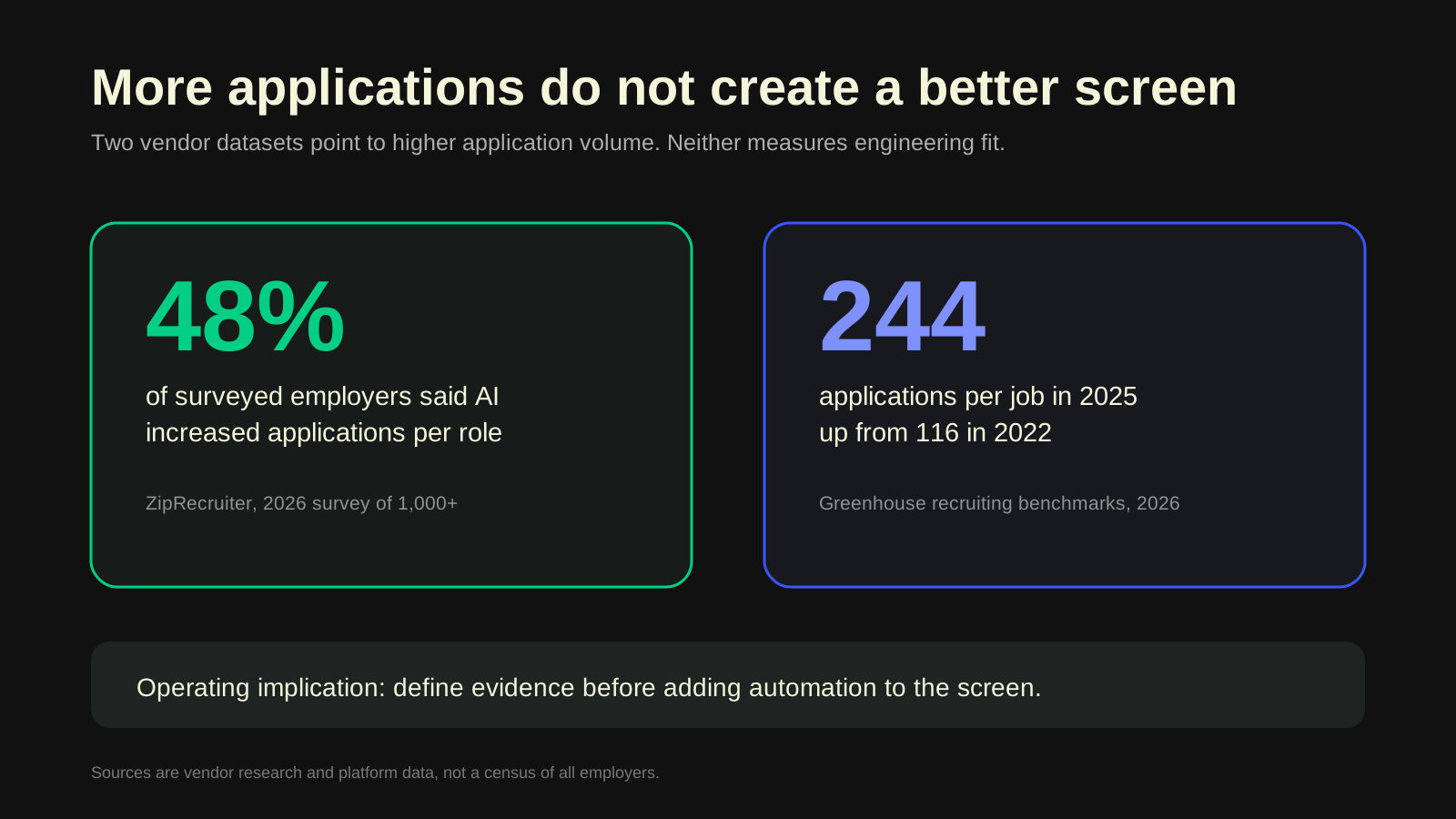
More applications can widen access to a role. They can also create a review problem when polished language, copied requirements, and automated submissions make weak and strong resumes look more alike.
What goes wrong with AI resume screening?
Four failures show up before the interview.
The role has no evidence standard. The job description lists technologies and years, but it does not say what the engineer must have built, operated, migrated, or improved.
The filter treats mention as proof. A candidate who repeats the stack can score above someone whose adjacent experience better predicts the work.
The hiring team cannot explain an advance or rejection. A score enters the ATS, but nobody can name the job-related evidence behind it.
Automation inherits the gaps in the process. A faster version of an unclear screen is still unclear.
These are not only quality concerns. An EEOC worker guide explains that algorithmic scoring can screen out people with disabilities. Employers remain responsible for how assessment tools affect applicants.
What should replace a keyword-first screen?
Use an evidence ladder. Define the minimum proof required at each stage, then use tools to organize that evidence rather than invent the standard.
For a backend role, the ladder might be:
- Work eligibility and nonnegotiable constraints. Location, schedule overlap, or another requirement that is necessary for the role.
- Relevant operating context. Evidence of building or operating systems with comparable reliability, data, integration, or scale constraints.
- Depth signal. A resume bullet, project description, or work sample that names the candidate's decision and its result.
- Technical verification. A short human screen that tests whether the candidate can explain the system, tradeoff, failure mode, and contribution.
- Role-specific interview. A structured exercise tied to the work the person will do, with a scoring guide agreed in advance.
The first two stages reduce obvious mismatch. The next three establish evidence. No single resume score should pretend to do all five.
The engineering job-description guide starts this work before the role opens. Scope, decision rights, operating conditions, and first-180-day outcomes give the screen something more useful than a list of tools to match.
How should humans review an AI-assisted shortlist?
Start with a calibration sample before the system touches the full pool.
Build a sample that covers clear matches, adjacent profiles, ambiguous cases, and obvious misses. Have two reviewers apply the evidence ladder without seeing an automated recommendation. Keep adding cases until each group is represented and the reviewers can explain their disagreements. Then compare the agreed result with the tool.
Record four things:
- Which evidence caused an application to advance?
- Which required evidence was missing?
- Where did reviewers disagree?
- Which tool recommendation did a reviewer override, and why?
NIST's AI Risk Management Framework organizes the work as govern, map, measure, and manage. For hiring, that means assigning responsibility, understanding the role and applicant context, measuring errors and overrides, and changing the screen when it fails.
Human review is not a ceremonial final click. The reviewer needs authority, role context, and a clear reason to challenge the recommendation.
Which metrics show whether the screen works?
Do not judge the screen by resumes processed per hour. Track whether it improves downstream decisions.
Use a small scorecard:
- Advance precision. What share of advanced candidates pass the first technical verification?
- Miss review. When a hiring manager rescues a rejected candidate, what evidence did the first screen miss?
- Stage conversion. Where do candidates from each source or screen outcome stop advancing?
- Override rate. How often do trained reviewers change the automated recommendation, and for what reason?
- Quality after hire. Which screening signals correlate with agreed performance or retention measures later?
Quality of hire needs a company-specific definition. LinkedIn's own vendor research, for example, defines a quality hire using 12-month retention plus at least one impact signal and reports stronger results for users of its AI product. That 110-million-member analysis is transparent about both its definition and product context. Define "quality" before asking a tool to improve it.
Can AI still help with the screen?
Yes. It can normalize information, surface missing fields, group applications for review, summarize evidence, schedule work, and help reviewers apply a consistent rubric.
The safe use is narrower than "let the model pick the engineers." The hiring team owns the criteria, reviews error patterns, keeps a path for accommodation and reconsideration, and verifies technical evidence with people who understand the work.
This is also why role level must be settled early. A screen for an execution leader and a screen for a function leader should not reward the same evidence. The Director-versus-VP role-leveling checklist helps define that boundary before the pool is scored.
FAQ
Can AI reject qualified candidates?
Yes. A model or rule can miss relevant evidence, overvalue proxies, or create discriminatory effects. Employers should test the process, retain human review, and follow applicable employment law.
Should an ATS auto-reject candidates without every listed technology?
Only when a requirement is necessary and job related. Many engineering skills transfer across tools. Test for the operating capability the role needs, not vocabulary alone.
How many applications should a recruiter review manually?
There is no universal number. Review enough of a calibrated sample to understand false positives, false negatives, and reviewer disagreement before scaling the filter.
What is the best first technical screen?
A short, structured conversation tied to evidence from the candidate's work. Ask them to explain a system, their contribution, a tradeoff, and what failed or changed.
What should you change before the next req opens?
Write the evidence ladder and test it on a small, mixed sample. Do not add another filter until the hiring team can explain why each candidate advances.
If applicant volume is already outrunning the team's review capacity, bring the role brief and current screen to a 15-minute TechOpX staffing fit check. The goal is a smaller, defensible pool, not a faster pile of scores.

