

Choose a software developer staffing agency that can define what candidates must demonstrate for your engineering work. It should also explain how it tests candidates against those requirements and show why each person advanced. A large database, fast promise, or familiar technology list does not prove the provider can produce a credible shortlist.
Evidence note. This guide evaluates a provider's process without claiming one universal screen or guaranteeing hiring outcomes.
Start the evaluation before a candidate arrives. Ask the agency to show the route from role brief to shortlist and listen for where technical judgment enters the process.
What does a software developer staffing agency do?
A staffing agency can recruit and employ or assign technical workers who support a client's team. The commercial and employment structure varies by service.
The American Staffing Association separates direct placement, long-term contract help, managed services, and recruitment process outsourcing. Those models buy different things. A direct-placement search ends in an employment relationship with the client. Contract staffing supplies capacity through another employment or engagement structure. RPO transfers part or all of a recruiting process.
Before comparing agencies, name which result you need. "Find developers" is not enough to distinguish a search partner, a staffing supplier, and a delivery vendor.
What should the agency ask before sourcing?
The first call should produce more than a copied job description.
A credible agency asks about:
- The system, product, or customer outcome the person will affect.
- The work they must own in the first 90 and 180 days.
- The team, manager, and decision rights around the role.
- The technical environment and which parts are required for the work.
- The failure modes the new person must be able to handle.
- The interview stages and who can evaluate each signal.
- The budget, location, schedule, and employment constraints.
Use those answers to refine the role brief. Remove requirements that are merely familiar and sharpen the ones that predict whether a candidate can do the work.
If the agency accepts "we need a Java developer" and immediately starts sending resumes, it has not yet learned enough to screen the role.
The engineering job-description framework gives the buyer a useful starting brief: scope, operating conditions, decision rights, and evidence of success.
How should an agency screen software developers?
The screen should test evidence in layers.
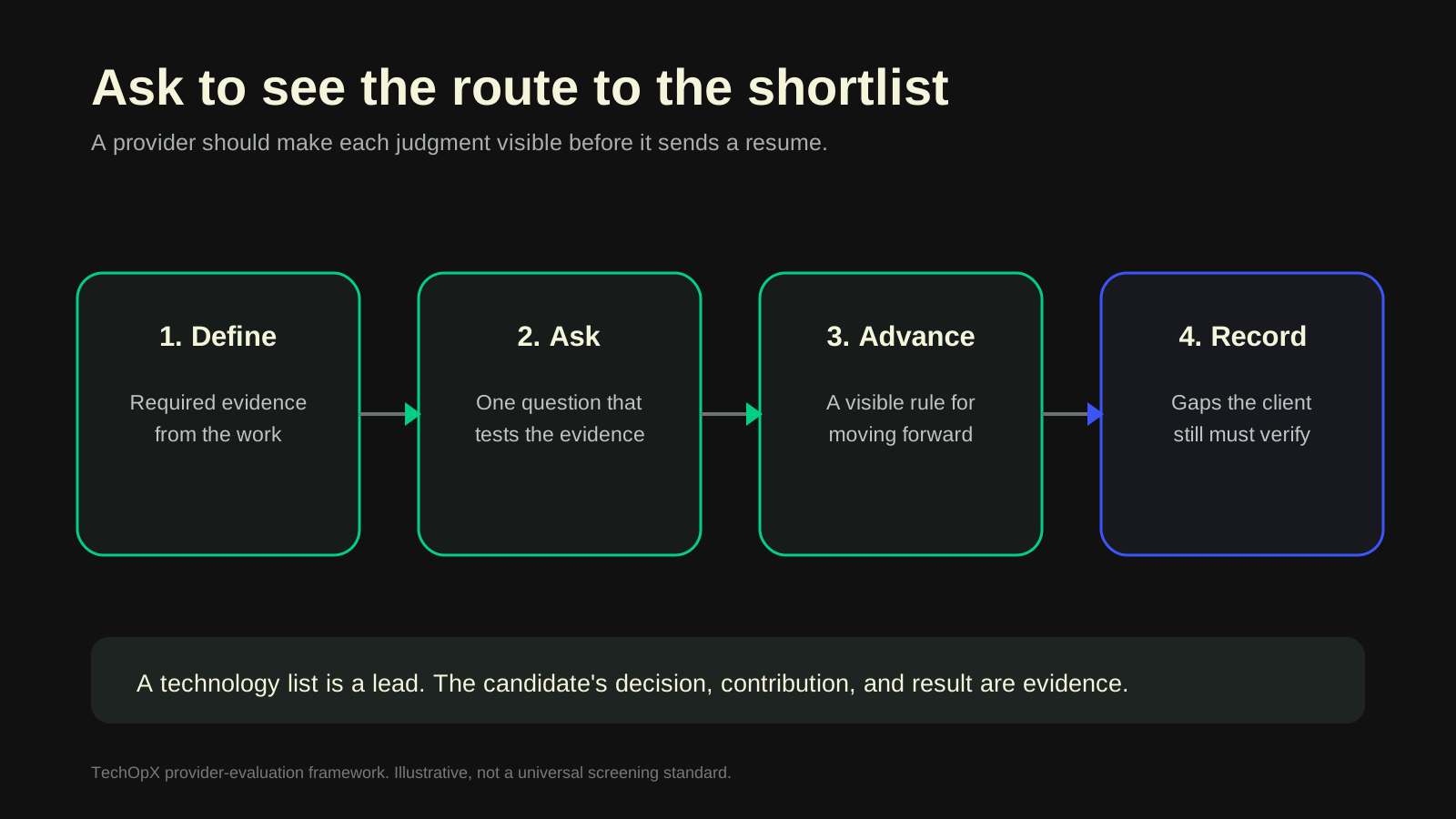
First, verify the constraints that determine eligibility. Second, look for experience with comparable systems and operating constraints. Matching words on a resume alone are not enough. Third, ask the candidate to explain a system, their contribution, a tradeoff, and what changed because of their work. Finally, route role-specific technical evidence to a qualified reviewer.
Ask the agency to show an anonymized scorecard. It should reveal:
- The evidence required to advance.
- Which questions test that evidence.
- Who reviews technical answers.
- How uncertainty is recorded.
- What the client still needs to verify.
The agency does not need to replace your engineering interview. It does need to remove obvious mismatch and provide enough evidence for the interview team to use its time well.
For illustration, a backend-integration screen might include one row like this:
Required evidenceScreen questionAdvance ruleUncertainty fieldOwned a production integration with retries or failure recovery"Walk through one integration failure. What detected it, what retried, and what did you change?"Candidate separates their contribution from the team's, explains the failure path, and names the tradeoffScale and on-call ownership still need verification
A resume that lists APIs and message queues is a lead, not evidence. The answer advances only when the candidate can connect the system, decision, and result.
Which seven questions expose the process?
Use these questions in every provider meeting:
- How will you turn this req into a screening rubric? Look for role-specific evidence, not a standard technology checklist.
- Who performs the technical screen? Ask what qualifies that reviewer to evaluate this work.
- What will every candidate brief contain? Expect evidence, uncertainty, compensation, availability, and the reason the person advanced.
- How do you handle a requirement that is shrinking the pool? The provider should bring market evidence and a tradeoff, not silently ignore the brief.
- What do you measure after submission? Stage conversion and rejection reasons are more useful than outreach volume alone.
- How are employment, access, and offboarding handled? Contract staffing needs operational controls as well as recruiting.
- What changes if the role or hiring plan changes? The agreement should define scope, pause, replacement, and conversion rules before they are needed.
The answers make providers comparable even when pricing models differ.
On the first question, a weak answer is, "We match the stack and years of experience." A stronger answer names the work, the evidence that would predict it, the question used to test that evidence, and the point where an engineering reviewer takes over.
What compliance questions belong in the review?
Staffing does not move employment responsibility into a black box.
The EEOC says employment agencies are covered by federal anti-discrimination laws when they regularly refer people to employers, and they may not make referrals based on protected characteristics. Separate contingent-worker guidance explains that a staffing firm, client, or both may qualify as an employer, depending on the relationship.
Ask how the agency documents job-related criteria, handles accommodation requests, trains reviewers, and responds to a discriminatory client request. A provider should be able to explain the process without promising that a tool makes it unbiased.
If background reports are used, the Federal Trade Commission notes that employers must follow the Fair Credit Reporting Act and applicable anti-discrimination requirements. Confirm which party obtains consent, sends required notices, and handles disputes.
These questions do not replace counsel. They show whether the provider has defined responsibility instead of assuming the other party owns it.
How should you evaluate security and access?
Treat a staffing provider as part of the technology supply chain when its workers will access code, systems, or data.
Ask who employs the worker, where work occurs, which subcontractors may be involved, how identity is verified, and who removes access. Match privileges to the role and set an offboarding clock.
NIST's 2026 supplier due-diligence guide is scoped to information and communications technology suppliers. Its categories include provenance, resilience, foundational cyber practices, and supply-chain tiers. TechOpX adapts those categories as prompts when a staffing provider's workers will access code, systems, or data. Not every engineering assignment needs a federal-style assessment, but the categories reveal what a vague "we vet everyone" answer leaves out.
For a restaurant or hospitality technology environment, access may cross ordering, payments, loyalty, guest data, venue operations, and vendor integrations. The provider should understand why the context changes the access plan.
What should a candidate brief contain?
A useful candidate brief lets the hiring manager understand the fit before opening a resume.
Require six fields:
- The candidate's relevant operating context.
- Evidence for each must-have criterion.
- The candidate's explanation of one comparable technical decision.
- Any gap or uncertainty the agency found.
- Compensation, location, availability, and work-authorization facts.
- The specific reason the agency recommends an interview.
This structure makes the agency accountable for judgment. It also lets the hiring team explain which evidence is insufficient and give the agency specific feedback to refine the search.
One row might read: "Integration reliability. Candidate described owning retry and idempotency changes after duplicate order events. They explained their code change and monitoring signal. Traffic scale and production on-call responsibility remain unverified." That gives the hiring manager a claim to test. "Strong backend engineer with API experience" does not.
The same principle applies to senior roles. The Director-versus-VP checklist helps prevent a provider from sourcing two different leadership mandates under one title.
How should you run a paid pilot?
If the agreement allows it, test one role or one defined workstream before expanding.
Set the rubric, reporting fields, response times, and client responsibilities in advance. Review the first five presented candidates together. Do not wait for a hire to learn that the provider misunderstood the role.
Score the pilot on:
- Evidence quality in the candidate brief.
- First technical-screen pass rate.
- Responsiveness to calibration.
- Candidate communication and process clarity.
- Accuracy of availability, compensation, and work constraints.
- Compliance with agreed access and data handling.
The pilot should show whether the provider learns in a controlled, visible way. A perfect first batch is not required.
FAQ
Should a staffing agency conduct coding tests?
Only when the test matches the work and a qualified reviewer can interpret it. A generic test can add friction without improving the shortlist.
How many candidates should an agency submit?
There is no universal number. A small set with clear evidence is more useful than a large set that pushes screening back to the client.
What is a reasonable replacement policy?
It depends on the service and agreement. Ask what triggers the policy, how long it lasts, what remedy applies, and which client actions can void it.
Should one agency handle every engineering role?
Only if it can demonstrate the relevant screening depth and delivery capacity across those roles. Start with the role family where its evidence is strongest.
What should you request from the next agency?
Ask for the screening rubric, anonymized candidate brief, reviewer qualifications, reporting sample, and access process before you ask for resumes.
Then compare the engagement model itself. The guide to subscription recruiting versus contingency search explains what each commercial structure buys. Bring the req and the seven provider questions to a 15-minute TechOpX staffing fit check to see how the role would move from brief to evidence-backed shortlist.

